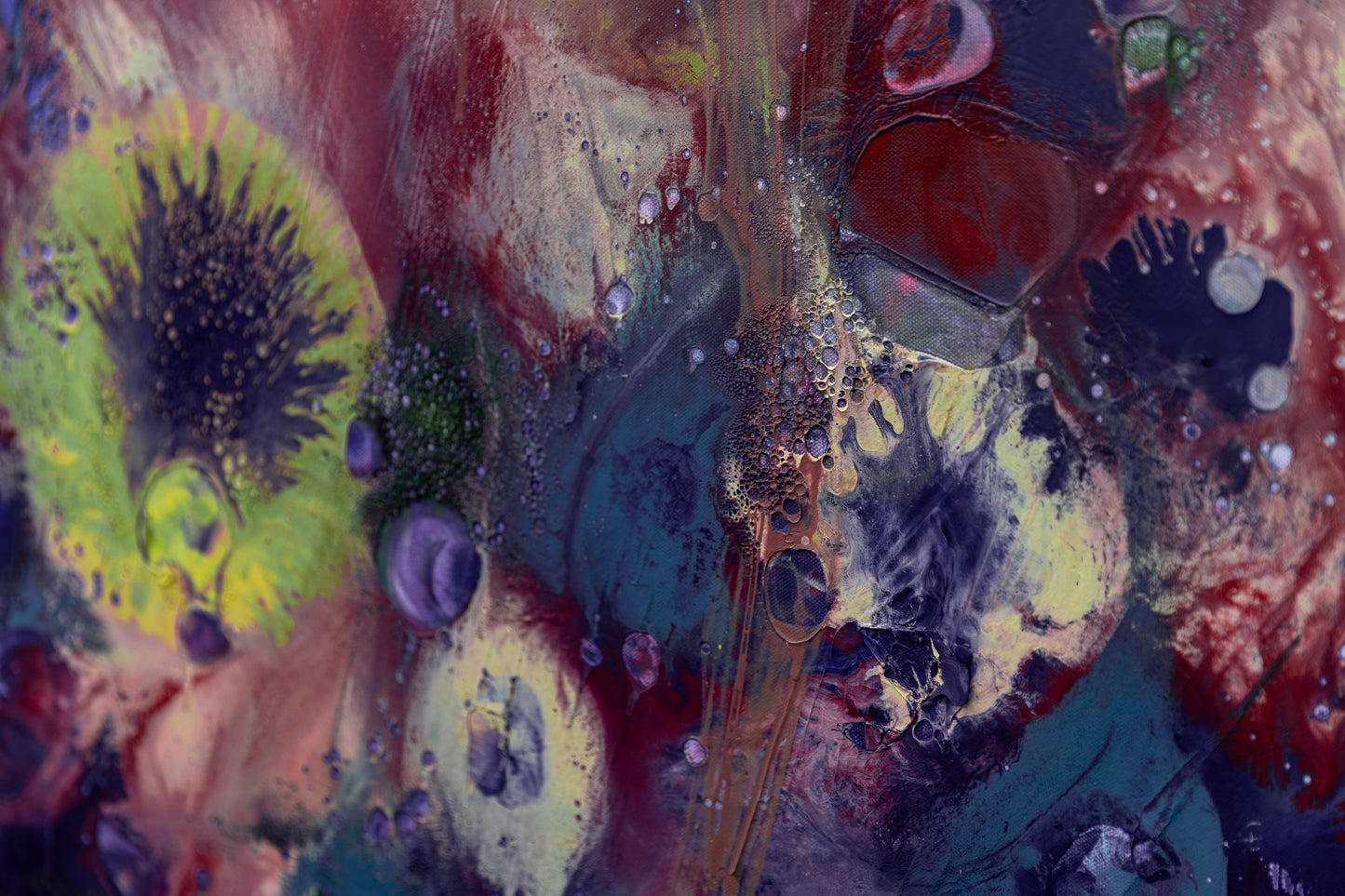
"Primordial Bloom" is large-scale (153 × 122 cm) cellular acrylic painting that immerses the viewer in an abstract ecosystem teeming with life-like energy. Fluid pours and layered reactions create intricate cellular structures that resemble magnified biological forms—spores, membranes, and blossoming organisms—suspended in a radiant yellow atmosphere.
The composition pulses with contrasts: fiery reds bleed into cool teals, while soft, cloud-like transitions dissolve into sharply defined cellular edges. These interactions suggest a moment of transformation—where growth and erosion coexist, and matter appears to evolve in real time. Subtle textures, bubbles, and lace-like patterns reward close viewing, revealing micro-worlds within the larger composition.
Balancing chaos and harmony, the painting invites interpretation: it can be seen as a cosmic nebula, a microscopic landscape, or an emotional terrain shaped by instinct and spontaneity. The luminous background acts as both light source and void, amplifying the sense of emergence and expansion. Cellular Symphony In Cellular Symphony, the canvas becomes a petri dish of cosmic proportions. The artist utilizes the unpredictable nature of fluid media to mirror the intricate patterns found in nature—from the branching of neurons to the clusters of living cells. The composition is built on a series of crescendos; the deep blue "bass notes" on the periphery provide a steady foundation, while the central surge of crimson and gold acts as a soaring melodic line that commands the viewer’s attention.
The brilliance of the work lies in its microscopic detail. Tiny, translucent orbs and lacy, web-like structures create a rhythmic texture that dances across the surface, giving the impression of constant growth and transformation. It is a celebration of the hidden architectures of life, suggesting that even in the smallest of spaces, there is a vast and colorful music waiting to be seen. This painting doesn't just sit still—it vibrates with the internal pulse of a living system.